
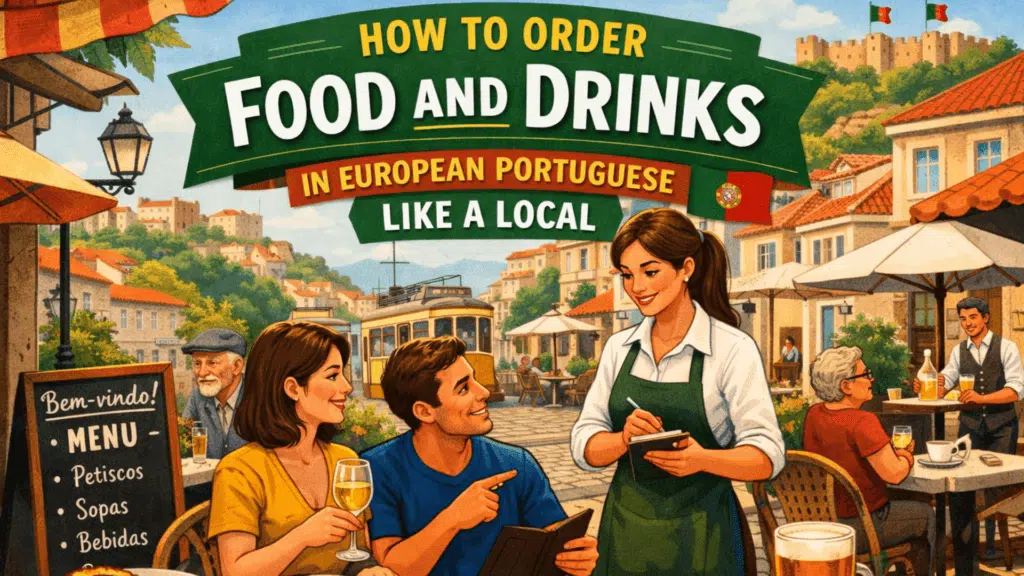

Ordering food in Portuguese can feel intimidating at first, especially when you want to sound like a true local.
But once you learn a handful of essential European Portuguese restaurant phrases, your confidence will grow quickly.
This complete guide is packed with helpful tips, natural transitions, and real-world examples to ensure you can order food in Portuguese with flair and politeness.
Ready to walk into any restaurant in Portugal and feel right at home? Vamos lá!
👉 Planning a trip? Check out our guide to the best time of year to visit Portugal — month by month to plan your visit perfectly.
1. Warm-Up: First Interactions When You Order Food in Portuguese
Start with greetings — making a great first impression is everything.
- Bom dia — Good morning
- Boa tarde — Good afternoon
- Boa noite — Good evening
Greeting your server with a smile and a polite “Bom dia” sets the tone for the whole meal. The Portuguese appreciate courtesy — it’s the first step to ordering food in Portuguese like a local.
2. Securing a Table
After greeting, the next step is asking for a table. Typically, you’d say:
- “Uma mesa para [número], por favor.”
- Uma mesa para dois, por favor. (A table for two, please.)
- Alternatively: “Tem mesa disponível?”
- Do you have a table available?
If it’s a busy time, be prepared for phrases like:
- “Para quando?”
- For when?
- “Em dez minutos?”
- In ten minutes?
Then, once you’re seated, the server may ask:
- “Quer ver o menu?”
- Would you like to see the menu?
3. Exploring the Menu in Portuguese
Here comes the fun part—reading the menu. In many places:
- “Posso ver o menu, por favor?”
- Can I see the menu, please?
- “Qual é o prato do dia?”
- What is the dish of the day?
Moreover, if you’re unsure what a dish means, you can ask:
- “O que é este prato?”
- What is this dish?
- “É picante?”
- Is it spicy?
- “Tem frutos do mar?”
- Does it have seafood?
In addition, asking for recommendations shows engagement:
- “O que recomenda?”
- What do you recommend?
- “Qual é o seu prato preferido aqui?”
- What’s your favorite dish here?
4. How to Order Food in Portuguese: The Essential Phrases
When you’re ready to order food, consider using polite expressions:
- “Queria…”
- I would like…
- “Vou querer…”
- I’ll have…
For example:
- “Queria o bacalhau com natas, por favor.”
- I’d like the cod with cream, please.
- “Vou querer o arroz de marisco.”
- I’ll have the seafood rice.
- “Para mim, o prato do dia, por favor.”
- For me, the dish of the day, please.
Besides, if you have dietary restrictions:
- “Sou vegetariano/vegetariana.”
- “Há opções vegetarianas?”
- “Sem glúten / sem lactose, por favor.”
5. Ordering Drinks in Portuguese
Similarly, when ordering drinks, use these phrases:
- “Queria uma água sem gás, por favor.”
- I’d like still water, please.
- “Um café, por favor.”
- A coffee, please.
- “Um copo de vinho tinto/branco, por favor.”
- A glass of red/white wine, please.
- “Uma cerveja, por favor.”
- A beer, please.
If you’d like something specific:
- “Um sumo de laranja natural.”
- A natural orange juice.
- “Um café com leite.”
- A coffee with milk.
Furthermore, if it’s a bar or takeaway scenario:
- “Para levar, por favor.”
- (To take away, please.)
- “Posso ter um to-go cup?”
- May I have a to-go cup?
6. Making Special Requests
At times, you might want to ask for extra items or modifications:
- “Pode trazer mais pão?”
- Can you bring more bread?
- “Sem cebola, por favor.”
- No onions, please.
- “Mais picante?”
- More spicy?
- “Acompanhe com arroz ou batatas?”
- Is it served with rice or potatoes?
Also, remember to use transitional words such as “então”, “logo”, and “finalmente”, to connect your thoughts naturally.
7. Checking and Confirming Your Order
Once the order is taken, the server might repeat it to confirm:
- “Um bacalhau com natas e uma água sem gás, certo?”
- Cod with cream and a still water, right?
- You can confirm with: “Sim, está certo, obrigado(a).”
Additionally, if the order is incorrect, kindly say:
- “Desculpe, mas pedi…”
- Sorry, but I ordered…
8. During the Meal
You may want to ask during the meal:
- “Pode trazer mais água?”
- Could you bring more water?
- “Está delicioso!”
- It’s delicious!
- “Está um pouco salgado/doce.”
- It’s a bit salty/sweet.
Moreover, if something is missing:
- “Faltam os talheres.”
- The cutlery is missing.
- “Pode trazer guardanapos, por favor?”
- Could you bring napkins, please?
9. Asking for the Bill and Paying
As the meal winds down:
- “A conta, por favor.”
- The bill, please.
- “Posso pagar com cartão?”
- Can I pay by card?
- Alternatively: “Quanto fica?”
- How much is it?
Moreover, if you want to split the bill:
- “Podemos dividir a conta?”
- Can we split the bill?
When paying:
- “Aqui tem.”
- Here you go. (when handing cash/card)
- “Fica com o troco.”
- Keep the change.
10. Departing with Gratitude
Before leaving, always end with politeness:
- “Obrigado/a! Estava tudo ótimo.”
- Thank you! Everything was great.
- “Boa continuação!”
- Have a good rest of your day/evening!
- “Até logo!”
- See you later!
Besides, if it’s a takeaway order:
- “Obrigada, até amanhã.”
- Thanks, see you tomorrow.
11. Full Example: Ordering Food in Portuguese from Start to Finish
To help connect everything, here’s a full example conversation:
Cliente: “Boa tarde. Tem mesa para dois, por favor?”
Funcionário(a): “Boa tarde. Claro, sigam-me, por aqui, por favor.”
Cliente: “Obrigado. Posso ver o menu, por favor?”
Funcionário(a): “Claro, aqui está. O prato do dia é arroz de marisco.”
Cliente: “Ótimo. Queria esse arroz de marisco e uma água com gás, por favor.”
Funcionário(a): “Arroz de marisco e água com gás. Querem entrada?”
Cliente: “Sim, por favor. Pode trazer uma salada mista?”
Funcionário(a): “Claro. Mais alguma coisa?”
Cliente: “Não, é tudo. Obrigado.”
(Mais tarde…)
Cliente: “A conta, por favor.”
Funcionário(a): “Com certeza. Aqui tem.”
Cliente: “Obrigado! Fique com o troco. Estava tudo ótimo.”
Funcionário(a): “Obrigado a vocês! Tenham uma boa tarde.”
12. Portuguese Dining Etiquette
To sound even more local when you order food in Portuguese, keep these tips in mind:
Tipping: Leaving 5–10% is appreciated in Portugal, but not mandatory.
Useful phrase: Say “Bom apetite” before starting your meal.
Pace: Meals are social events — don’t rush.
Table setting: Fork on the left, knife on the right.
Patience: Service is relaxed — embracing that is part of the experience.
According to Visit Portugal, gastronomy is one of the country’s top attractions — knowing how to order food in Portuguese transforms your travel experience completely.
13. Quick Reference Table: Order Food in Portuguese
| Situation | Portuguese Phrase | English Translation |
|---|---|---|
| 👋 Greeting | Bom dia / Boa tarde / Boa noite | Good morning / afternoon / evening |
| 🪑 Ask for a table | Uma mesa para dois, por favor | A table for two, please |
| 📖 Ask for the menu | Posso ver o menu, por favor? | Can I see the menu, please? |
| ⭐ Ask for recommendation | O que recomenda? | What do you recommend? |
| 🍲 Order food | Queria o bacalhau com natas, por favor. | I’d like the cod with cream, please |
| 🍷 Order drinks | Um copo de vinho tinto, por favor. | A glass of red wine, please |
| 💳 Ask for the bill | A conta, por favor. | The bill, please |
| 💰 Pay | Posso pagar com cartão? | Can I pay by card? |
| 🙏 Thank the staff | Obrigado/a! Estava ótimo! | Thank you! It was great! |
14. Practice Makes Perfect
Mastering how to order food in Portuguese takes consistent practice. Here are some proven tips:
Repeat out loud: Say the phrases you’ve learned every day — even 5 minutes makes a difference.
Role-play: Practise with a friend or language tutor.
Watch Portuguese cooking shows: Listen to natural dialogue and menu vocabulary in context.
Immerse yourself: Visit Portuguese cafés and apply these phrases in real situations.
👉 Want to go even further? Discover how to speak like a local with the European Portuguese slang guide and impress everyone in Portugal.
15. Why Learning to Order Food in Portuguese Matters
Finally, why is this worth the effort?
It boosts your confidence: Feeling comfortable in real conversations accelerates your overall fluency.
It builds genuine rapport: Locals deeply appreciate when you make the effort — and often go out of their way to help.
It enriches your travel experience: You’ll access authentic cuisine and local favourites far beyond tourist menus.
It sharpens your ear: Understanding fast service phrases improves your European Portuguese listening skills dramatically.
✅ Conclusion and Action Plan
- Memorise the key phrases from each section.
- Practise how to order food in Portuguese in real or simulated settings.
- Immerse yourself through Portuguese shows and menus.
- Apply everything in Portugal — and smile! 😄
Which phrase are you most excited to use first? Drop it in the comments below!